
How will the permanent residency exam change? What will the new A2 Czech exam format look like from April 2026? This is the most frequent question this year. Let’s take a closer look! What? Why? What stays the same? And most importantly: how to prepare without stress and chaos?
What Is Changing in the Exam? What Stays the Same?
From 11 April 2026, two parts of the A2 Czech exam for permanent residency are changing:
👉 Writing,
👉 Speaking.
The structure of tasks, scoring and assessment will change.
The trend is clear: more practical communication and more initiative from the candidate.
What does NOT change:
✅ The exam is still at A2 level.
✅ The total number of points and the passing threshold remain the same (60% from the written test, 60% from speaking).
Speaking: More Structure, More Student Initiative
Task 1: Dialogue About You
In the old format (until 11 April 2026), you receive one topic and the examiner asks you 10 questions.
In the new format (from 11 April 2026), you receive two topics, each with 4 questions.
This is actually fair – you won’t stay in one topic for too long, but you need to switch quickly.


What stays the same?
- Answer in full sentences. If asked Where do you live?, say I live in Prague. — not just In Prague.
- If you don’t understand or need the question repeated, you can ask for clarification (in Czech!).
- The list of topic areas remains the same: housing, food, daily routine, free time, work, health, shopping and services, travel, education, environment (nature, city, etc.) and weather.
What is different?
- You will see 2 topics instead of 1.
- The task is worth fewer points (8 instead of 12).
How to prepare?
- Practice vocabulary across all topics.
- Practice quick reactions and switching topics.
Task 2: Formal Dialogue
In the old format, you react to a situation in a dialogue (for example making a phone call, solving a problem, buying something).
In the new format (2026), the dialogue will be more structured and you will receive clear instructions about what to say.
You must ask 4 questions in each dialogue. Three questions follow instructions on the card; the fourth is your own question (here you can be creative).


What stays the same?
- You complete 2 dialogues.
- Dialogues are formal: you must use polite forms and formal phrases (Good afternoon, Goodbye, etc.).
What is different?
- You take the main initiative. Learn to ask questions about price, place, time, types of goods, details, etc.
- You do not need to react extensively to the examiner, so listening skills are less central than before.
Task 3: Monologue in the Past Tense
In the old format, you tell a story in the past tense based on written prompts.
In the new format (2026), you receive 4 pictures and create a story in the past tense.


What stays the same?
- The monologue is in the past tense.
- Grammar accuracy is important, especially past tense forms (e.g. byl/byla/byli).
- You structure your story: first, then, finally, etc.
What is different?
- You will no longer see written prompts.
- You will see 4 illustrations and must comment on each one.
- The task is now more important (10 points instead of 6).
Task 4: Informal Dialogue
This part remains the same in the new version.
You receive 3 pictures and must agree with the examiner on one option (e.g. choosing a gift, a holiday destination, a trip programme).
You must also explain what you prefer and why.

Writing
Task 1: Form
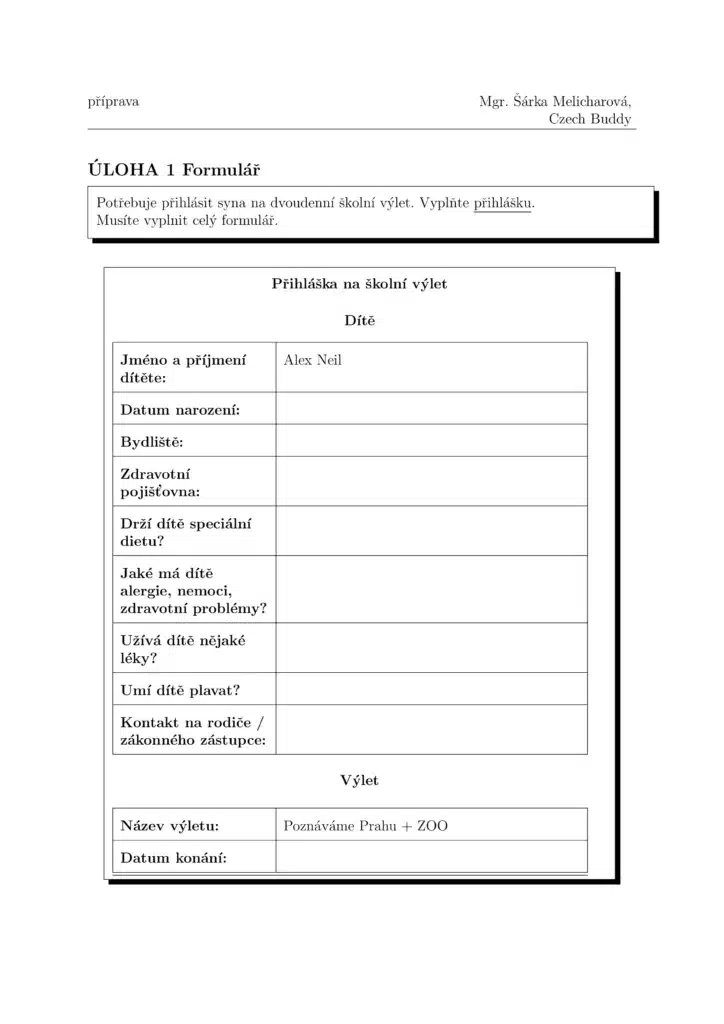
In the old format, Task 1 is a form with short personal details.
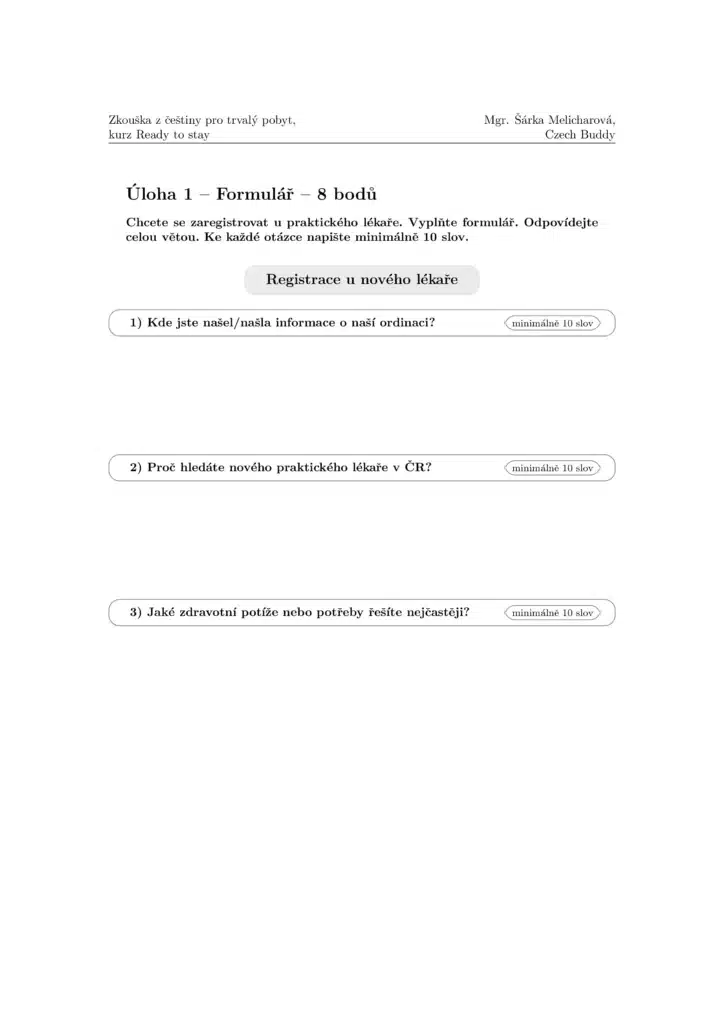
In the new format, Task 1 is a form combined with a short survey. You must answer three questions in full sentences, with a minimum of 10 words per answer.
What is different?
- You now write full sentences.
- You provide more varied information (what you like, what you did, why you went somewhere, etc.).
- The task is worth 8 points instead of 5.
Task 2: Email
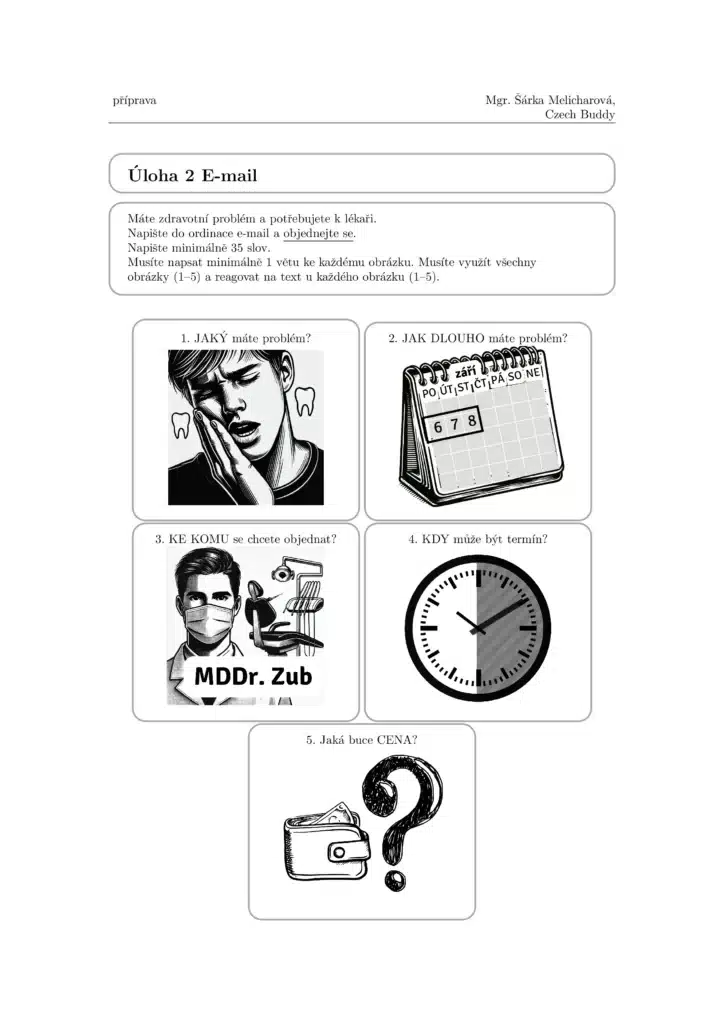
In both versions, you write an email/letter reacting to 5 pictures and short prompts.
What changes is the scoring.
Old format: 5 points for the form, 15 for the email.
New format: 8 points for the form, 12 for the email.
Overview of Changes
This table summarises the key differences between the old and new formats.
| Section | Before 11 April 2026 | From 11 April 2026 |
|---|---|---|
| TASK 1 – Writing | Form: short personal details | Form: full sentences |
| TASK 1 – Speaking | 10 questions, one topic | 8 questions, two topics |
| TASK 2 – Speaking | You respond to the examiner in a dialogue | You ask the examiner questions based on instructions |
| TASK 3 – Speaking | Monologue based on 3 written prompts | Monologue based on 4 illustrations |
How to Prepare Without Panic
✅ Go through official A2 model tests (available here)
✅ Practice real-life situations and vocabulary
✅ Focus on practical skills: speaking, reacting, improvising, staying calm
✅ The goal is not perfection. The goal is being good enough.
If you need help preparing, you can book individual lessons.
If you are taking the old format, I can also help you with writing practice.
We can do this together. 💙
