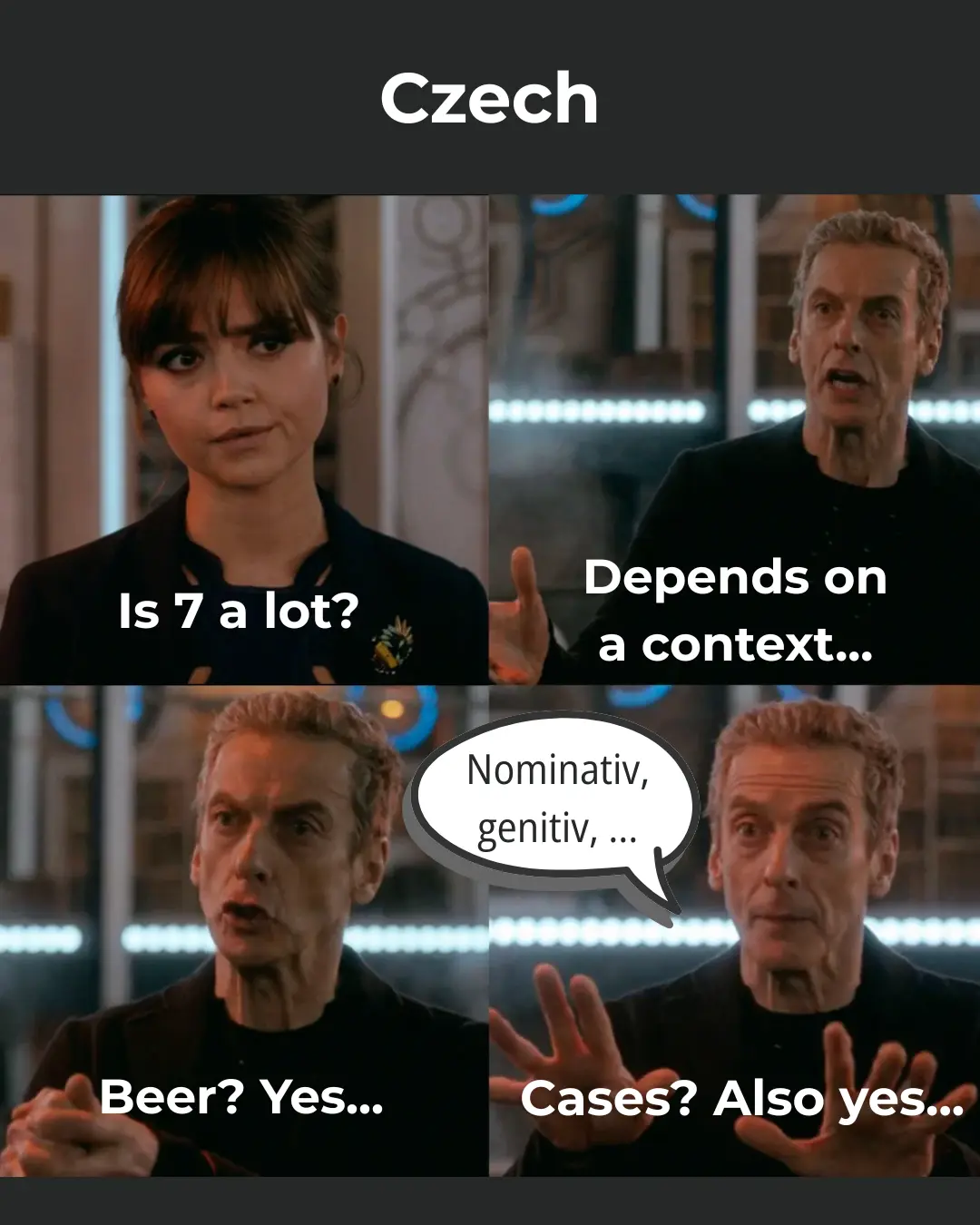
Do you find yourself in a desperate need of Czech language meme? I am here to save you! I believe that humor is the best way to make learning more enjoyable. That is why I created this collection of Czech language memes. Because if you can understand the joke, you are not just laughing—you are actually understanding the logic (or the lack of it) behind the language.
Here are my memes explained—featuring the Doctor, me, and the beautiful chaos of Czech grammar.
What is too much in Czechia?
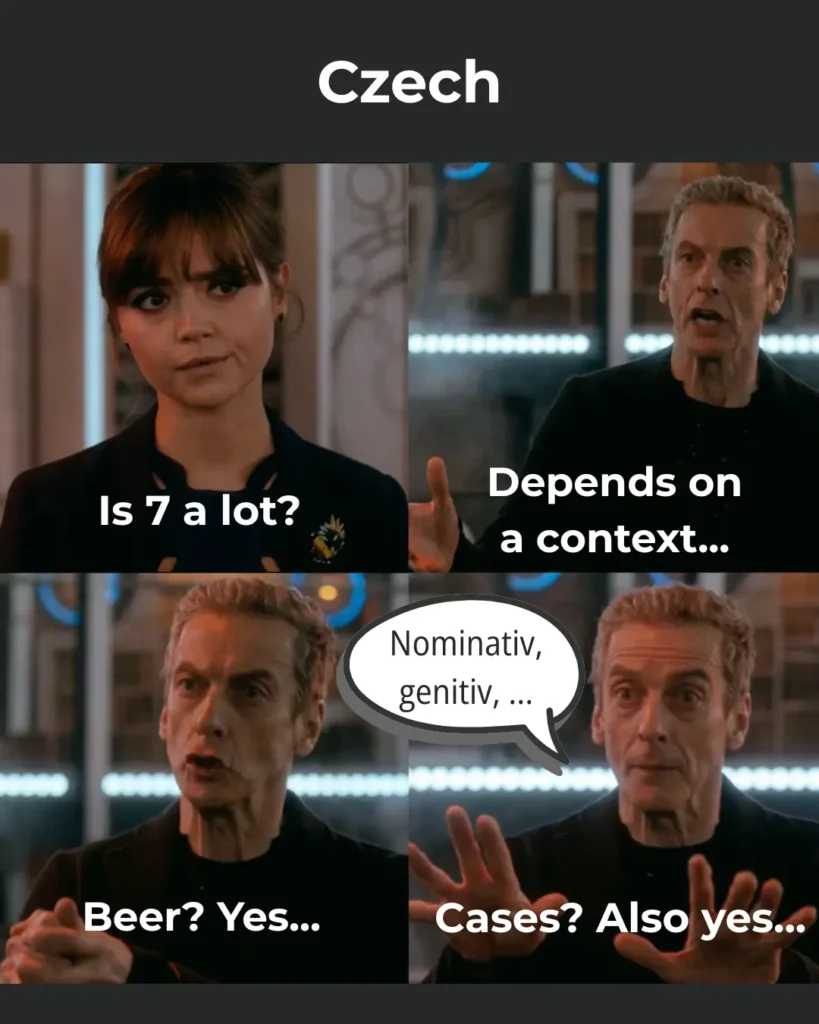
Czechs are world champions in beer consumption, but let’s be honest—7 beers in one sitting is a lot, even by local standards. That’s a heavy night out! (For me, even 2 are too much.)
However, the number 7 is (in)famous for a different reason. The Czech language has 7 grammatical cases (gramatický pád). While English relies on word order, Czech relies on changing the endings of words based on their role in the sentence.
This means you have to learn 7 different versions of every noun, adjective, and pronoun (singular and plural!).
- Nominative (Kdo/co?)
- Genitive (Bez koho/čeho?)
- Dative (Ke komu/čemu?)
- Accusative (Vidím koho/co?)
- Vocative (Oslovujeme!)
- Locative (O kom/čem?)
- Instrumental (S kým/čím?)
So yes, 7 is definitely “a lot” when you are trying to order just one beer correctly!
How to count in Czech
Counting in English is easy: one cat, two cats, five cats, a million cats. Simple, right? In Czech, however, simple math turns into a grammar workout. As this meme shows, the number 5 is a magical barrier where everything changes.
We have 3 different situations based on how many items you are counting. Let’s look at the word Kočka (Cat) or Pivo (Beer):
1. The Singular (Number 1) Everything is normal.
- 1 kočka
- 1 pivo
2. The Simple Plural (Numbers 2, 3, 4) Here we use the Nominative Plural.
- 2, 3, 4 kočky
- 2, 3, 4 piva
3. The “Massive” Plural (Numbers 5 and more) Once you hit number 5, Czech logic assumes “that is a lot of stuff” and switches to the Genitive Plural and the verb in singuler. This is the trap from the meme!
- 5 (or 10, or 100) koček: pět koček má jídlo (five cats have food)
- 5 (or 10, or 100) piv
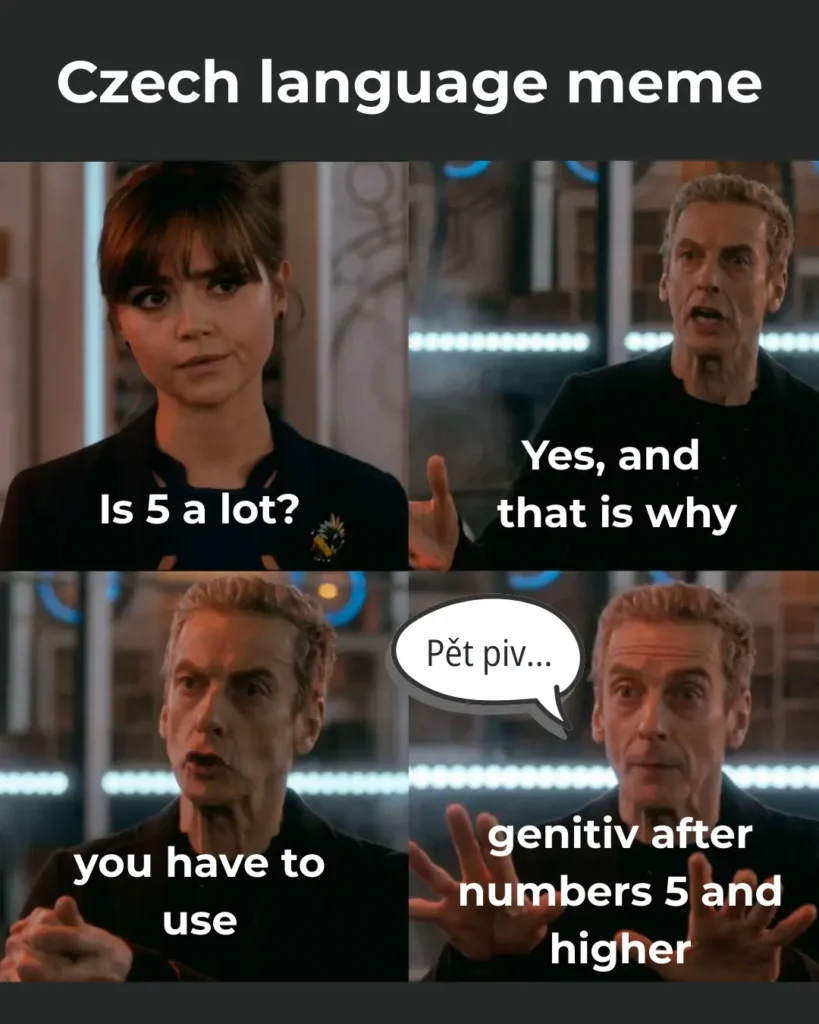
It is funny? Or painful? You decide…
Synonyms
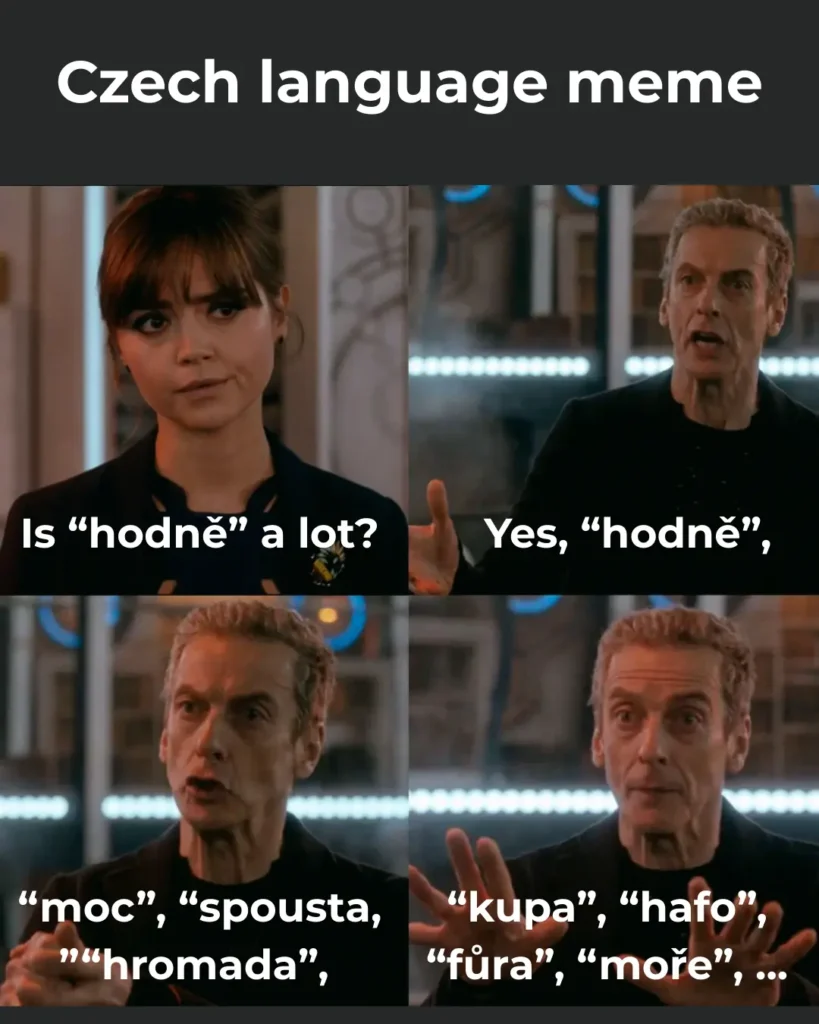
When you learn Czech from a textbook, you learn one word or two words for “a lot”: Hodně. You feel safe. You feel ready.
(And you are ready! Synonyms, that is a topic for level B1+, B2, …)
And then you walk into a Czech pub or talk to a friend, and suddenly, there are other words as well. Czechs love to be expressive, so we have dozens of ways to say that there is a large quantity of something.
In this meme, the Doctor lists the most common ones you will hear in daily life. Here is how to understand them:
The Classics (Safe to use anywhere)
- Hodně / Moc: The standard “a lot” or “very much”.
The “Pile” Logic (Visualizing the amount) Czechs like to imagine the quantity as a physical heap.
- Hromada: Literally a “pile” (hromada písku = pile of sand).
- Kupa: A “heap” or “mound” (kupa dětí = a heap of kids/loads of kids).
- Fůra: Originally a “wagon load” (fůra práce = loads of work).
- Spousta: A mass or multitude. Very common!
The Nature Metaphors
- Moře: Literally “sea”. (Mám moře času = I have a sea of time / tons of time).
The Slang
- Hafo: Very common colloquial slang for “a lot”. (Je tam hafo lidí = There are heaps of people).
Another exception?!
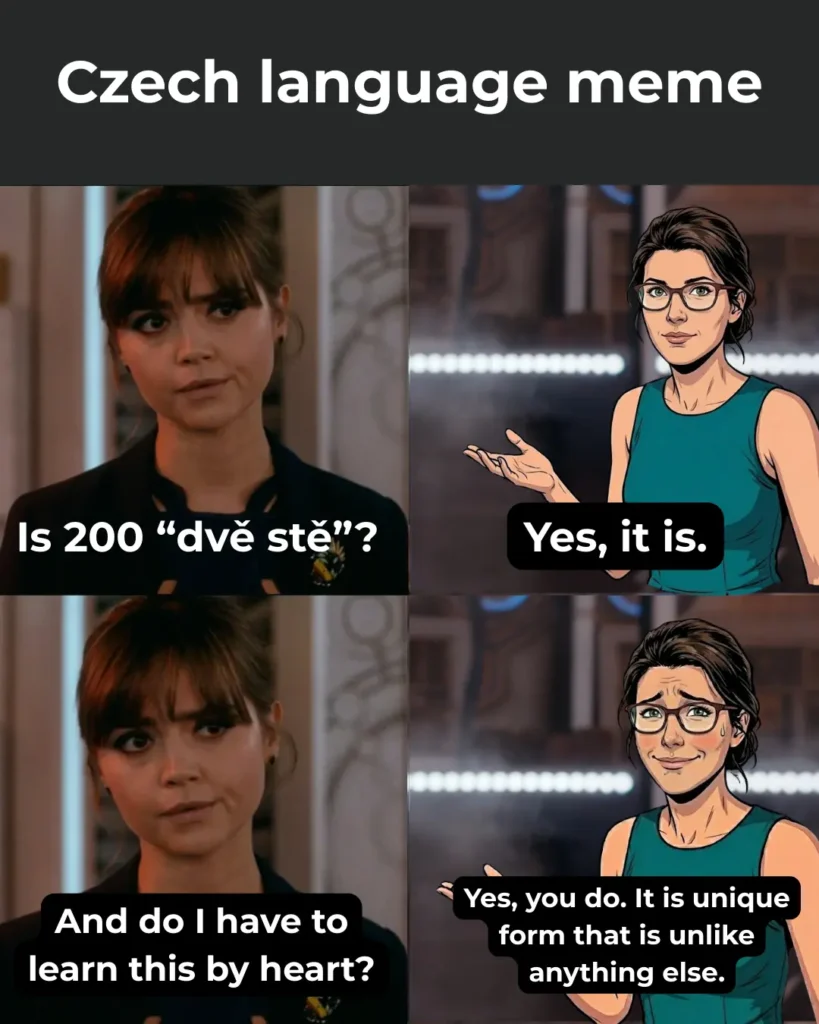
If you look for logic in Czech numbers, you will find it… mostly. But the number 200 is a glitch in the Matrix.
When you learn hundreds, you usually see this pattern:
- 100 = sto
- 300, 400 = tři sta, čtyři sta
- 500, 600, 700 = pět set, šest šet, sedm set, …
And then there is 200. Logic suggests it should be “dva sta”, right? Wrong. It is dvě stě.
Why is it so weird? As the meme suggests, it is a unique form. It is actually a historical remnant of the Dual Number (duál). Centuries ago, Czech had singular, plural, and “dual” (used for pairs of things). The dual mostly disappeared, but it survived in couple of words/phrases and the number 200.
Another exception, you see?
Number 15
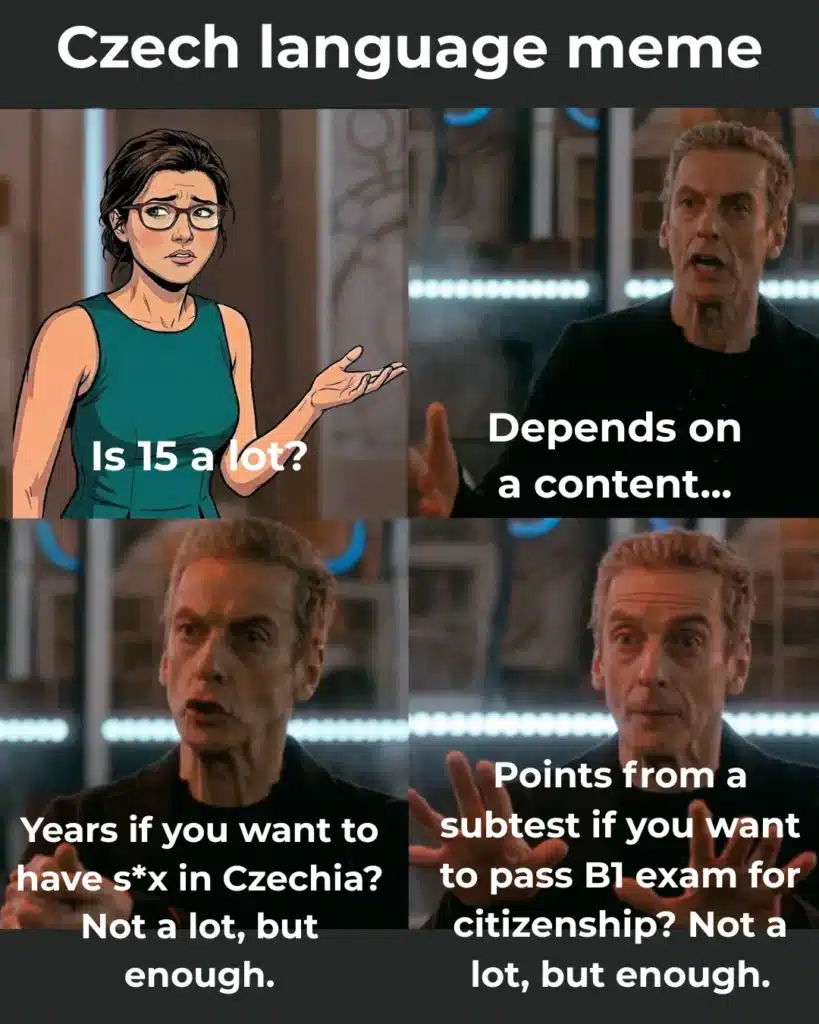
This meme touches on two very different, yet crucial facts about life in the Czech Republic involving the number 15.
1. Age of Consent First, the meme references the fact that legal age of consent is 15 years.
2. The Citizenship Struggle (B1 Exam Scoring) Second, and more importantly for your studies, is the Czech Citizenship Exam (CCE-B1). To become a Czech citizen, you must pass a rigorous language test. The test is divided into parts (Reading, Listening, Writing, Speaking).
- Each subtest has a maximum of 25 points.
- The passing threshold is generally 60%.
- 60% of 25 is… 15 points.
So, if you score exactly 15 points on your Writing or Listening test, you are walking on thin ice. It is “not a lot” (it is literally the bare minimum), but it is “enough” to pass and get your passport.
Study Tip: Don’t aim for 15. Aim for 25. The stress during the exam can easily cost you those few precious points!
We learn, don’t we?
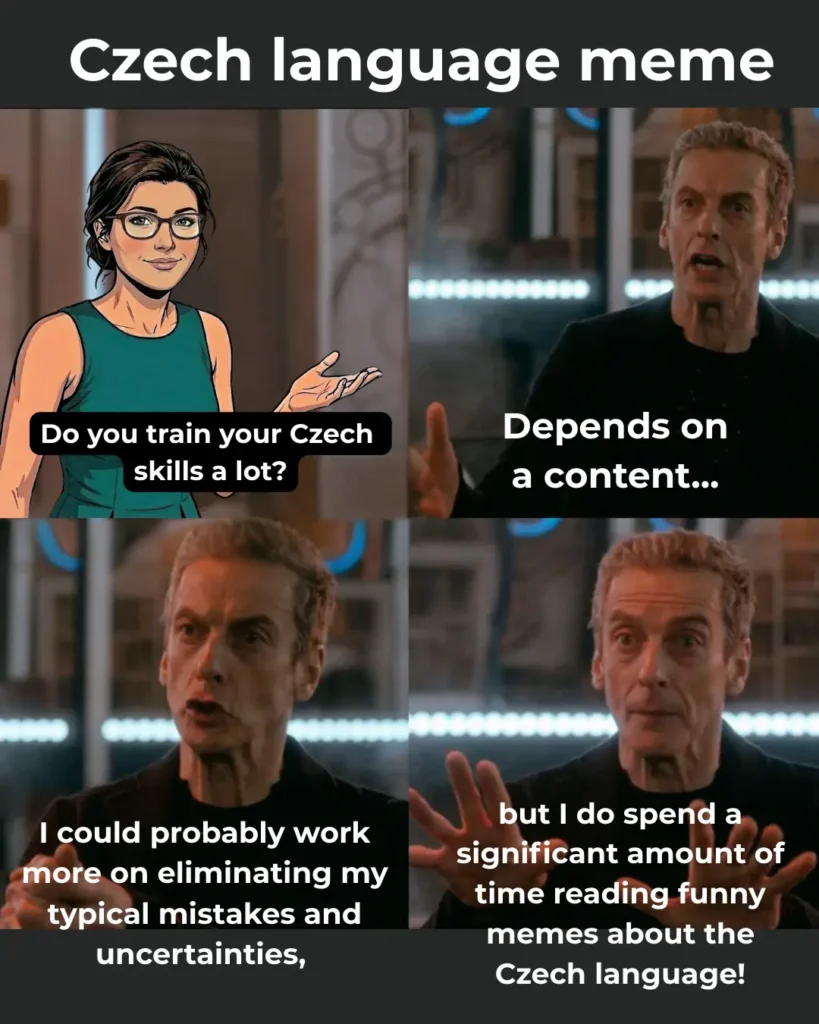
We all know that feeling. You should be opening your textbook. You should be practicing.
But instead, you are scrolling through Instagram or Reddit, looking at funny pictures.
Is it procrastination? Yes. Is it useless? Absolutely not!
(At least I hope that you are learning something about the Czech language or consolidating your knowledge in this article.)
So, don’t feel guilty. You are not “wasting time”. You are doing “Contextual Analysis”. (That sounds much better, right?)
Do you want more?
Well, I am not a wizard. I am a teacher. I am Czech buddy, your friendly guide to a better Czech.
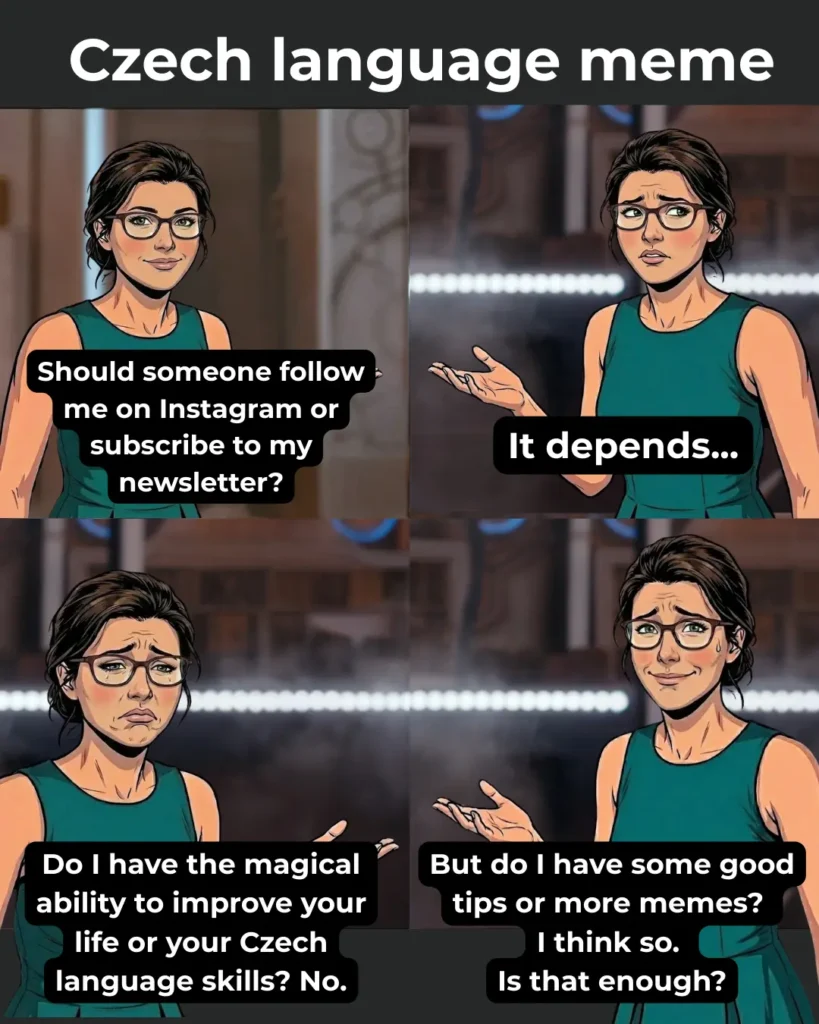
Well, I am not a wizard. I am a teacher. I am Czech buddy, your friendly guide to a better Czech.
As this meme admits, I cannot snap my fingers and download the Czech grammar into your brain (unfortunately!). You still have to do the work. However, I can make that work much less painful.
My goal isn’t to be a magician, but a guide who makes sure you don’t get lost in the forest of declensions and conjugations—and that you have a good laugh along the way.
Can I serve you more similar content? If so, please subscribe to my newsletter. 🙂
You can also follow me here:
📸 For Quick Bites & Laughs: 👉 Instagram Follow me for daily doses of Czech humor, quick vocabulary tips, and behind-the-scenes reality. It’s the best way to procrastinate productively.
🎥 For Deep Learning: 👉 YouTube Need more than just a picture? Check out my educational videos where I explain the “why” and “how” of Czech grammar in depth (but still with a smile).
🤝 For the Professionals: 👉 LinkedIn Are you working in a Czech office? Let’s connect professionally. Here I share insights on “Business Czech,” career-related vocabulary, and discussions that go a bit deeper than a 10-second reel.
And if you need help with Czech, check out my individual lessons or contact me if you have something else on mind.
