Are you planning to apply for permanent residency in the Czech Republic but not sure what the Czech A2 language exam is really like?
This guide will walk you through everything — what to expect, how the test is structured, how long it takes, and how the scoring works. It will help you prepare effectively and pass on your first try.
Get comfortable and dive in — this is your practical guide to understanding the A2 Czech exam.
If you want to apply for permanent residency in the Czech Republic, you’ll need to prove that your Czech is at least at
level A2.
But before you sign up for the exam, check if you might be exempt from this requirement:
If none of these situations apply to you, you’ll need to prove that your Czech is at level A2 or higher.
The most straightforward way is to take the A2 Czech Language Exam for Permanent Residency. Here’s a little secret — it’s also the easiest and most convenient option.
There are also other ways to prove you have A2 level:
In most cases, you won’t qualify for an exemption — which means you’ll likely take the
A2 Czech Language Exam for Permanent Residency. Let’s take a closer look at what it includes and how to prepare effectively.
So what exactly does the exam look like? You’ll find the full structure in the table below. Take a good look — it shows the number of tasks, points, and time limits for each skill: reading, writing, listening, and speaking.
| Exam Part | Skill | Number of Tasks | Points | Time Limit | Passing Requirement |
|---|---|---|---|---|---|
| Written Exam ✍️✍️✍️ | Reading | 5 tasks | 25 points | 40 minutes | 60% total — at least 42 out of 70 points |
| Writing | 2 tasks | 20 points | 25 minutes | ||
| Listening | 5 tasks | 25 points | 40 minutes | ||
| Oral Exam 💋💋💋 | Speaking | 4 tasks | 40 points | 15 minutes | 60% total — at least 24 out of 40 points |
You don’t need to score 60% in reading, 60% in writing, 60% in listening, and 60% in speaking separately!
You only need 60% in the speaking part — because when you live in the Czech Republic, communication in real life matters the most: at the doctor’s, in a shop, or with colleagues.
The remaining three skills (reading, writing, listening) make up the written exam. You need 60% total across all three. That means you can have a slightly weaker area (for example, reading) as long as you make up the points in another part of the written test.
You might be wondering what your exam day will actually look like.
Here’s what to expect: you’ll start with the written exam,
which consists of the following parts — taken in this order:
After that comes another break. This one can be short — but sometimes it can be quite long
(even a few hours). That’s because every candidate needs to take the speaking part individually,
and usually there are many people taking the exam on the same day.
So be prepared — not just mentally, but also practically: bring something to eat and drink.
The last part of the exam is the oral exam = speaking.
Then you can finally go home, relax, and wait for your results. 😊
No matter what your Czech level is, it’s essential to get familiar with every part of the exam. Even if you speak like a native Czech, you could still lose points and/or the exam — simply because you didn’t do what the task asked for.
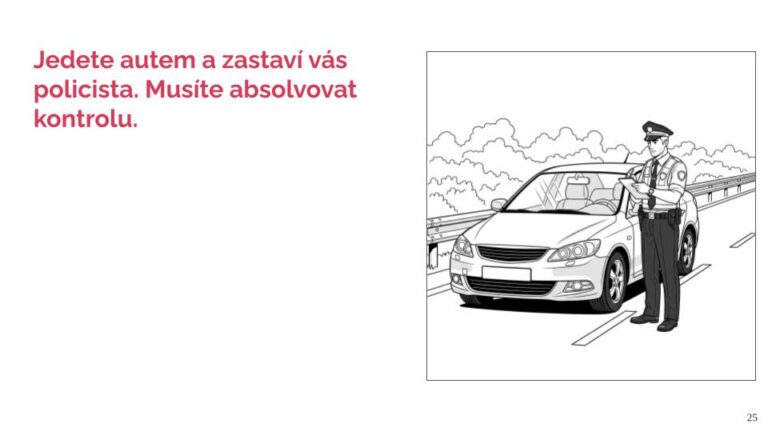
Here’s an example of one speaking task:
If you start explaining to the examiner that you don’t drive and have never spoken to a police officer in Czech, you won’t complete the task and you’ll lose valuable points.
In this task, you’re supposed to act out a short role-play with the examiner on the given topic. Your goal is to lead a formal dialogue, respond to questions, and
complete the task (in this case, to go through a police check).
Once you know this, it’s clear how to prepare:
You should approach each task in this systematic way.
That way, you’ll have a solid strategy — and you’ll be able to take the Czech language exam for permanent residency with confidence and a strong chance of success.
To get permanent residency in the Czech Republic, you need to prove that your Czech is
at level A2 or higher.
That’s why you’ll most likely take the A2 Czech Language Exam for Permanent Residency.
This exam checks whether you understand everyday situations and can communicate in basic Czech across different contexts.
You don’t need perfect grammar — what matters is practical language use and
a very good understanding of the exam format.
They include practice tasks, writing exercises, and explanations of how each part is scored.
With these, you can simulate the real exam, see what to expect, and identify what you still need to work on.
Or just send me a message and we’ll go through it together!